
This fragment belongs to the world of Ashes & Iron — a historical noir saga shaped by industry, borderlands, and the quiet decisions that determine who is carried forward and who is not.
Lost Chapters are moments that never found their way into the main volumes: scenes too small to alter history, yet heavy enough to leave a mark. They can be read in any order. They are not required to understand the books — but they reveal the forces that move beneath them, patiently, like winter water beneath ice.
Winter arrived early that year, the way it sometimes does when no one is watching closely. The river answered first. Not with noise, but with patience. It slowed. It thickened. It learned the shape of itself again.
Along the banks of Saint Brigid, the water took on a dull, metallic color, like old tools left out overnight. Men said it would hold by morning. Boys said it already did. No one tested it on purpose.
By dawn, the ice had formed in sheets thin enough to lie convincingly still, thick enough to invite mistakes. Fog clung low to the surface, turning distance into rumor. The far bank existed only as a darker absence.
Someone had crossed too late. Or too early. Or not carefully enough.
By the time the shouting reached the parish, the river had already decided what it would keep.
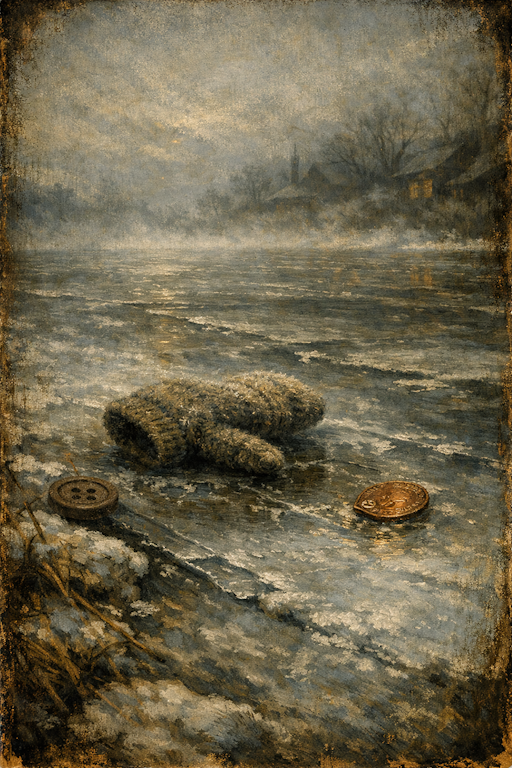
They found the first thing near the bank, frozen halfway into slush: a coat button, brown and unremarkable, the kind sewn by the dozen and never noticed until it was gone. Someone bent to retrieve it, then thought better of it. The ice around it cracked faintly, like a warning delivered politely.
A little farther downstream, a child’s mitten rested palm-up against the skim ice, wool darkened with water, fingers stiff and reaching. It had come loose cleanly, as if released rather than torn away.
The penny was last. Tarnished, flattened thin from years of circulation, caught in a shallow eddy where the ice hesitated to seal. It was the sort of coin no one bent to pick up under normal circumstances. Not worth the cold. Not worth the trouble.
Today, it felt like evidence.
They stood in a loose line along the bank, boots sinking into snow churned hard by indecision. No one spoke loudly. The river did not need encouragement. It kept moving beneath the ice, slow and deliberate, as if counting.
Someone said a name. It did not echo.
The men who arrived from the foundry stayed back. They knew better than to crowd a thing that could still be argued with. One of them removed his hat and held it against his chest, not for prayer, exactly, but out of habit. Another stared at the water as if waiting for it to apologize.
It did not.
By midmorning, the parish bell rang once. Not the full call. Just enough to mark the moment. Windows opened a fraction. Doors closed again. Inside kitchens, hands paused in the work of bread and tea, then resumed more carefully than before.
At the church, the steps were already damp where snow had been tracked in and melted without permission. A priest stood in the doorway, collar turned up against the cold, watching the men along the riverbank as if they were figures in a painting he had seen once and hoped not to recognize again.
No prayers were offered aloud. Not yet.
The river gave back nothing else. It did not argue. It did not perform. It simply continued, carrying its silence beneath the ice as if silence were a kind of cargo it had learned to transport efficiently.
By afternoon, the discussion shifted from rescue to recovery, from possibility to procedure. Ropes were brought out and laid carefully on the ground, their ends coiled like sleeping animals. Someone tested the ice with a long pole, tapping once, then again, listening for the sound that meant refusal.
The sound came quickly.
They marked the place with a branch stuck upright in the snow, a gesture more symbolic than useful. Everyone knew the river would move it before nightfall.
The boys were told to go home. Most did. One lingered at the edge, hands shoved deep into his pockets, fingers worrying a stone he had meant to throw earlier and never had. He watched the fog thin and thicken again, watched the ice flex in places it shouldn’t have, and learned something he would not be able to unlearn.
When his mother asked where he had been, he said only, “By the river.”
That was enough.
As the light faded, the men began to leave in ones and twos. No one wanted to be the last to turn away. The foundry whistle blew on schedule, sharp and familiar, and the sound cut cleanly through the quiet, offering something ordinary to hold onto. The river did not react.
At dusk, someone returned briefly to the bank and retrieved the penny. It came free with a small sound, like a breath released. The mitten and the button were left where they were. No one could say why, exactly. Some things felt better accounted for by absence.
By nightfall, the ice had thickened. What had looked uncertain in the morning now appeared confident, smooth, almost generous. Snow dusted its surface lightly, covering the faint cracks, softening the places where the river had hesitated.
From a distance, it looked safe again.
The parish learned, as it always did, to adjust. A place was set at one table and not at another. A coat was hung and not claimed. A name was spoken once more, quietly, and then not again.
The river moved on.
It always did.
And beneath the ice, it kept what it had taken—not out of cruelty, but out of habit. The way systems do. The way winter does. The way a place learns to survive by deciding, without ceremony, what cannot be returned.
The ice had taken inventory.
Some things are not lost. They are counted.
This moment belongs to the larger world of Ashes & Iron.
The full saga begins where these fragments leave off.

Leave a Reply