

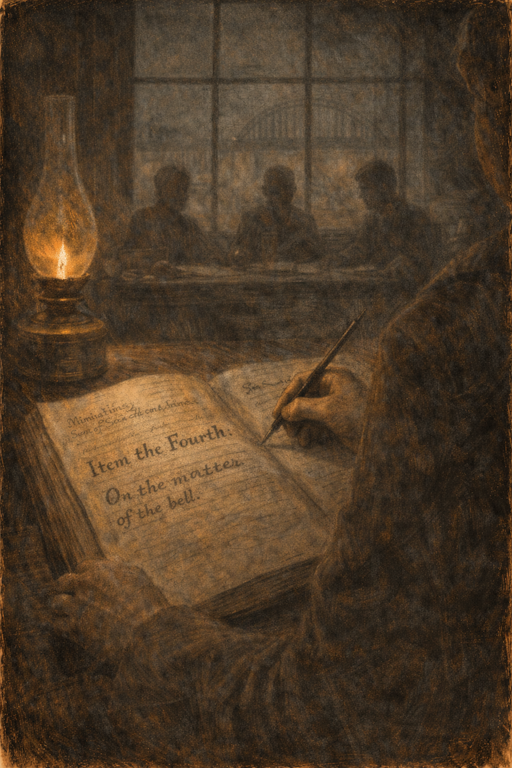
This fragment belongs to the world of Ashes & Iron, where institutions move carefully and words are weighed before they are recorded. Lost Chapters are moments preserved in margins and minutes: decisions shaped by silence, dissent noted without argument, and warnings that arrive without signatures. They can be read in any order. They are not required to understand the books — but they reveal how authority, faith, and restraint shape lives without ever raising their voices.
From the minutes of Saint Brigid, recorded in a hand that never shook.
The secretary’s script was consistent—loops measured, lines straight, margins respected. Even when the room grew crowded. Even when voices rose. Even when the weight of a discussion pressed against the table hard enough to make the ink hesitate.
Item the Fourth.
On the matter of the bell.
It was proposed that the bell be rung earlier on fog days, as an aid to those crossing the Ironmouth Bridge when the river offered no horizon and the air swallowed distance. The reasoning was practical. The bridge did not move, but the world around it did. Men misjudged steps. Wagons drifted too close to edges they could not see.
The motion carried.
All but one.
The dissent was not theological. No scripture was cited. No appeal was made to tradition or propriety. It was practical in a different way.
“The bell,” said Mister Dugas, “cannot make a man careful. It cannot make ice thick. It cannot hold a boy by the collar when foolishness runs ahead of sense.”
He did not raise his voice. He did not repeat himself.
No one answered him.
The silence was allowed to stand in the record, unchallenged. The secretary wrote it as absence rather than argument, the way such things were often recorded. There was a pause long enough for the room to notice itself breathing, then the meeting moved on.
They let the silence remain the way they let the river stand in winter: present, unarguable, cold enough to shape behavior.
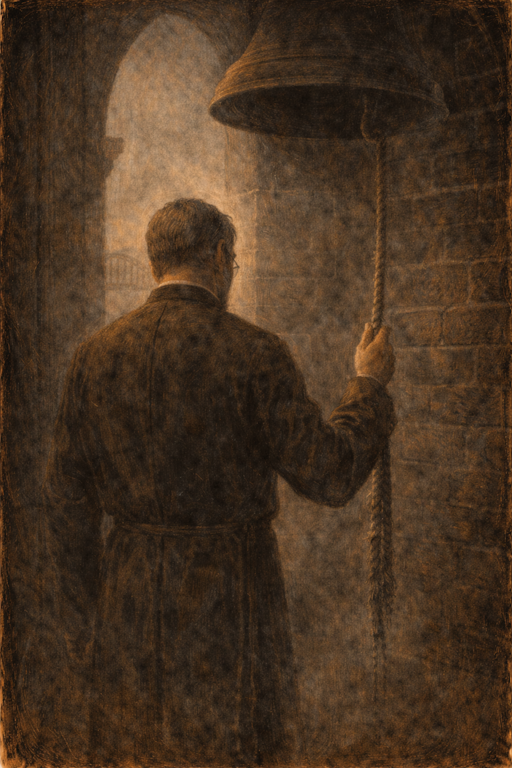
Later—after the chairs were stacked and the lamps dimmed—the priest returned alone to the bell tower. He did not climb the steps at first. He stood at the base, listening, as if the building might still be speaking.
When he reached the bell, he found the rope damp.
Not wet. Not soaked.
Damp, as if someone had held it too long with bare hands.
No one admitted to ringing it.
And in Saint Brigid, that meant the bell had rung anyway.
Some warnings sound even when no one claims to have given them.
This moment belongs to the larger world of Ashes & Iron.
The full saga begins where these fragments leave off.

Leave a Reply