 Skip to content

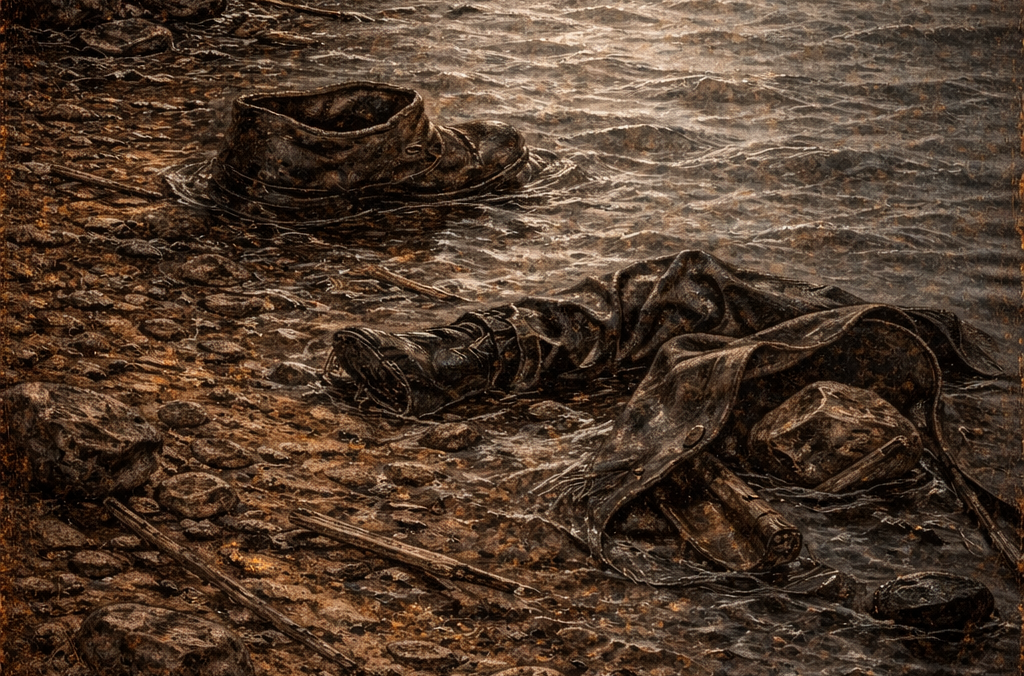
This fragment belongs to the world of Ashes & Iron, where memory is shaped as much by what is recovered as by what is taken.
Lost Chapters linger on moments that resist explanation: objects laid out on cold ground, conversations that circle without landing, conclusions drawn because they must be. These scenes can be read in any order. They are not required to understand the books — but they reveal how communities assign meaning when certainty refuses to surface, and how silence becomes a form of record.
The river always gave something back.
That was how it kept people talking. How it earned a reputation for fairness it did not deserve. A thing that returned anything at all could be argued with. Could be forgiven. Could be believed.
Most days, it was harmless things.
A stick carried too far from shore.
A hat lifted by wind and lost to laughter.
Someone’s bad idea, bruised but floating, retrieved with cold hands and relief.
The town pointed and said, See?
It lets go.
They said it loudly, as if repetition might turn observation into law.
But sometimes the river returned what it had finished with.
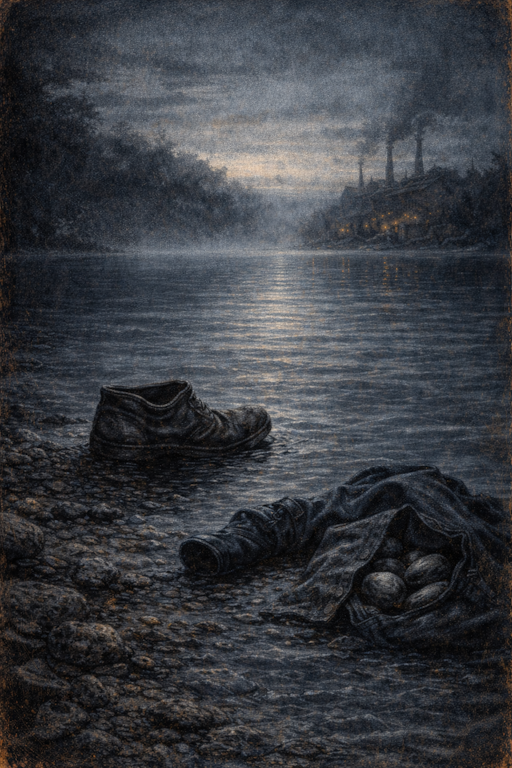
A boot, turned sideways, leather stiffened and darkened by water.
A sleeve, still knotted at the cuff, the fabric worn thin where fingers had worried it.
A pocket heavy with stones that were never meant to be carried, gathered in a hurry by someone who believed weight could argue with current.
No face.
No name.
Just enough.
They laid the pieces on the bank, arranging them carefully, as if order itself might coax meaning from what was left. Men stood with hands in pockets. Women crossed their arms against the cold and did not uncross them. No one bent close enough to claim certainty.
It was never enough to agree.
One said the river had warned him.
Another said warnings came too late to matter.
Someone else said carelessness always left a mark somewhere.
The argument stayed civil. It always did. Warm rooms encouraged moderation. Windows steamed. Cups were refilled. The pieces outside did not change.
No one asked the river to explain itself.
They only looked at one another, waiting for someone else to say what it meant.
The river did not interrupt. It did not clarify. It did not insist on being understood.
It had already done its part.
It returned what it could.
And then it waited—
patiently—
to be believed.
Evidence does not explain itself.
This moment belongs to the larger world of Ashes & Iron.
The full saga begins where these fragments leave off.

Leave a Reply