 Skip to content

This fragment belongs to the world of Ashes & Iron, where borders are crossed long before they are understood, and winter arrives with its own ledger already open.
Lost Chapters capture moments that unfold quietly: departures made before dawn, decisions carried in silence, objects that outlast the people who needed them. These scenes can be read in any order. They are not required to understand the books — but they reveal how industry, necessity, and survival begin shaping lives well before anyone calls it destiny.
The second frost came with a sky like sheet metal—flat, pale, unforgiving. It laid itself over Saint Brigid as if the day had been stamped in a press and slid out still warm at the edges, imperfect but final.
Jonas went out before the others woke. Quietly, the way you do anything you already know will become a story. His coat was half-buttoned, the collar stiff against his jaw. His boots were tied too tight, knots pulled hard as if pressure alone might keep the cold from getting in.
On the kitchen table, his mother had left bread under a cloth and a cup turned upside down so dust wouldn’t settle inside it. There was no note. There never was. Notes were for people who believed the world paused long enough to read them.
Outside, the river made no sound. That was what frightened him most—the way danger could be polite.
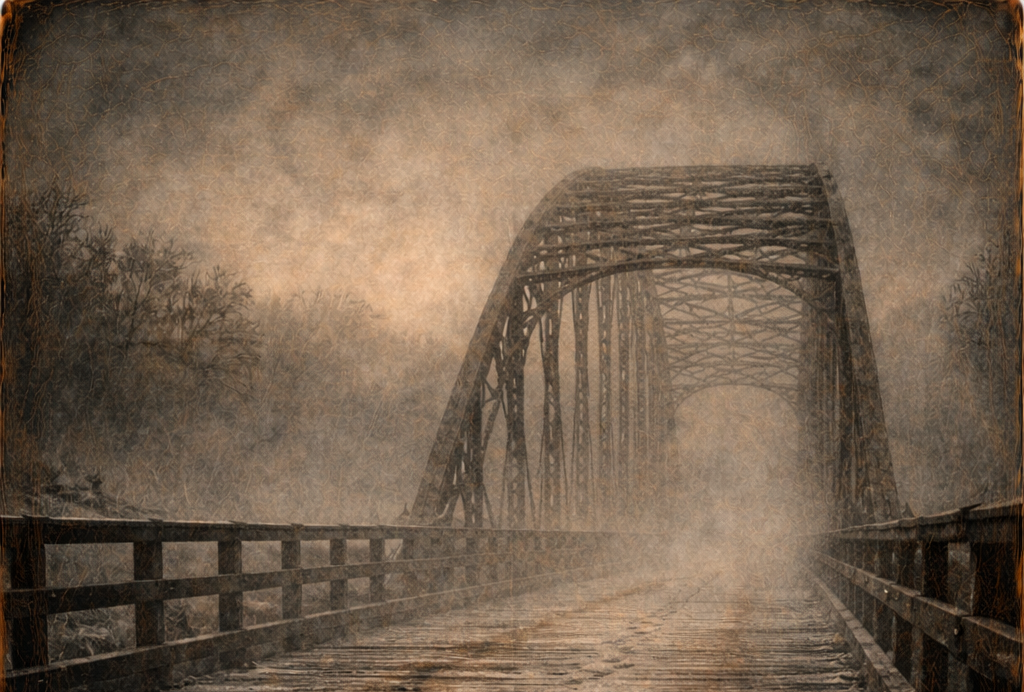
From the parish side, Ironmouth Bridge rose out of the fog like a black sentence. Jonas stepped onto the first plank and felt the bridge answer him—an old, low complaint in its bones. Not quite a creak. Not quite a warning.
Halfway across, he saw tracks on the boards. Small steps. Quick steps. Not a man’s stride. The marks were already softening at the edges, as if frost had begun to erase what the bridge carried.
He told himself it was nothing. That boys ran everywhere. That the bridge did not belong to any one boy’s fate.
But he followed anyway.
On the far bank, the foundry sat where it always sat—too large for the river to ignore. Varn & Sons looked less like a building and more like a decision someone had made and refused to reconsider. Brick. Iron. Tall windows turning weak sun into a dull, stubborn glow.
Even closed, it held heat the way a church holds incense—clinging to the air, sinking into cloth, making everything smell faintly of devotion and ash.
Jonas didn’t go to the gates. He wasn’t foolish. The guards knew the boys by their haircuts and their hunger. He kept to the side road, where weeds grew black with soot and the ground was packed hard by carts and boots.
Beneath the shadow of the wall, he found what he was looking for.
A small bundle wrapped in burlap, tied with twine. He knelt and touched it like it might burn him.
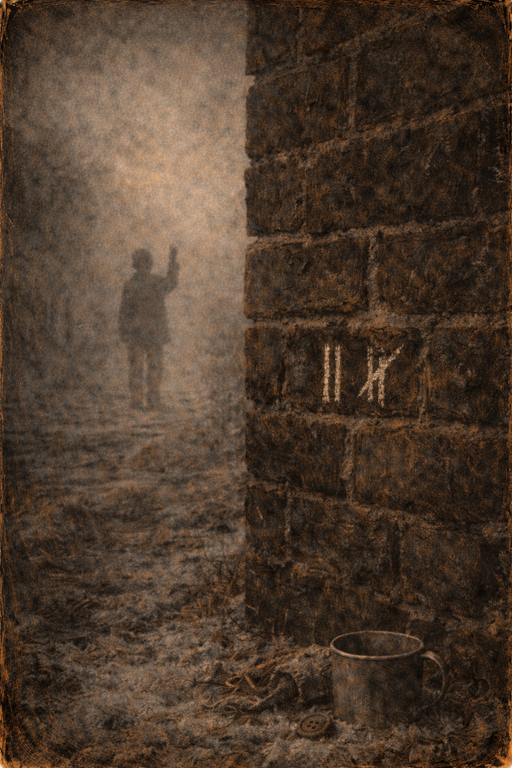
Inside was a scarf—old, patched, still faintly damp, as if it had been breathed through in a hurry. A tin cup with a dent in the lip. A piece of chalk. And a button—plain and brown—the kind that comes off coats when winter fights for them.
A boy had been here. Close enough to the foundry to feel its warmth through brick. Close enough to steal what he needed from the world without asking permission. Close enough to believe he could survive the river.
Jonas looked at the water. At the edges it had begun to skin itself—thin white lace where the current slowed. The middle stayed dark, moving with the patient confidence of something that had never once been punished for taking.
He thought of the men who said a river only takes the careless. He thought of the women who said the river takes whoever it pleases—and care is only a prayer you repeat so you can sleep.
He picked up the chalk and stood. On the brick, at child height, someone had already drawn a single line—a small white dash like the beginning of a sentence. Jonas added another line beside it. Not words. Not yet. Just a tally.
Because counting was the only kind of control a boy ever got.
Behind him, somewhere inside the foundry, metal shifted. A low groan. A settling beam. The exhale of a furnace banked too long. The sound traveled through brick and into his ribs.
He turned, expecting a man.
Instead, a figure stood at the far end of the service road. Smaller than a man. Shoulders narrow. Head bare in the cold. The boy stood perfectly still, as if he had learned that movement was what made you visible.
Jonas couldn’t see his face. Fog and distance ate the details. But he saw the boy lift a hand—two fingers raised. Quick. Precise. A signal.
Then the boy stepped backward into the fog and vanished, as if the world had decided it could not afford to keep him.
Jonas gathered the bundle under his arm. He did not run. Running was for boys who still believed speed could outrun consequence. He walked back toward the bridge, each step measured, each breath a small discipline.
On the planks, he paused and looked down through the gaps at the river moving beneath. He imagined the ice thick. He imagined it holding. He imagined, just once, what it would sound like if it didn’t.
And he understood why Saint Brigid rang bells and wrote minutes and argued in warm rooms about fog days.
Because a town is just a collection of people trying to convince themselves they can negotiate with winter.
Jonas crossed Ironmouth carrying someone else’s cup, someone else’s scarf, someone else’s button. It felt like carrying proof.
And proof, he had learned, was heavier than bread.
Proof is heavier than what keeps you alive.
This moment belongs to the larger world of Ashes & Iron.
The full saga begins where these fragments leave off.

Leave a Reply