

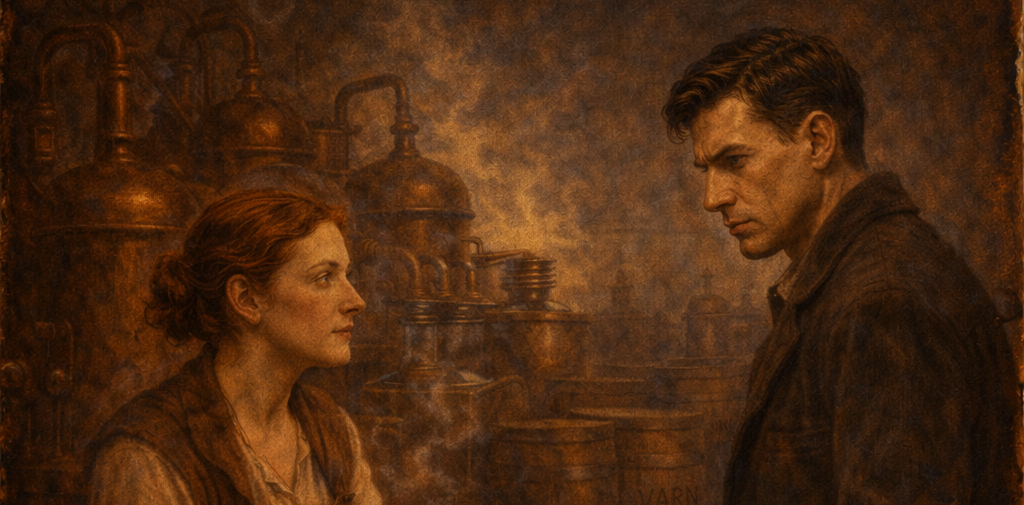
This fragment belongs to the world of Ashes & Iron, where crime is not born from ambition but from continuity.
Lost Chapters in the Quiet Trades cycle document the systems that keep a town alive when legality fails it: small beginnings, careful exchanges, and work divided among hands that know better than to ask for credit. These scenes can be read in any order. They are not required to understand the books — but they reveal how survival becomes structured, and how necessity, once organized, learns to endure.
It started small.
Under a parish oven, where heat was already expected and questions were rarely asked, a copper coil no bigger than a man’s arm sat hidden in plain sight. It was tucked into brickwork darkened by years of use, fed by fuel meant for bread and suppers and winter kitchens that could not afford inefficiency.
Maeva called it solvent.
Heat for kitchens. Cleaner for tools. A practical answer to practical problems. When the cold came early, it provided a little extra warmth for those who could not afford much else. No one objected. No one looked too closely. Nothing illegal yet.
Just careful.
On paper, everything remained clean.
The parish sold solvent to the foundry. Receipts were written clearly and filed properly, ink drying flat on pages that expected nothing more than routine. Barrels changed hands quietly, rolled across yards without ceremony.
Maeva sold.
Elias paid.
Not for drinking.
Not on paper.
Just enough to keep the ovens lit and the foundry supplied with what it needed to keep running. The arrangement sat comfortably inside existing habits. The paperwork made sense. The exchange did not draw attention to itself. That was the first rule.
Behind the foundry, the solvent changed its mind.
There, away from ledgers and loading docks, Jonas ran the stills. Slow work. Patient work. Exact work. Pressure watched. Valves eased by hand. Heat raised and lowered by instinct rather than gauge alone.
He learned the rhythm early. The sound a pipe made before it complained. The way vapor behaved when it was about to misbehave. What went in as something useful came out as something else entirely.
Something the law pretended did not exist.
The process did not hurry. Haste ruined more than it saved. Jonas worked the way the river worked: steadily, predictably, confident that repetition would eventually produce what was needed.
When the work reached its end, Silas took over.
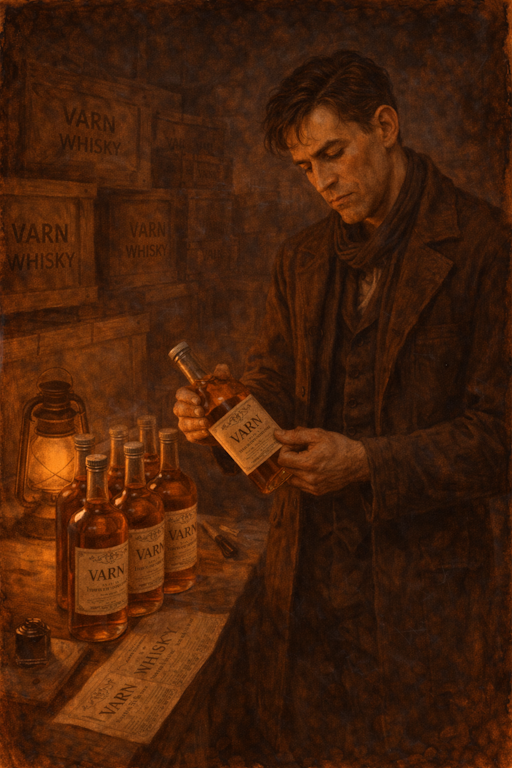
He did the last steps himself. Bottles washed until no residue remained. Filled carefully, necks wiped clean. Labels applied by hand. No speeches. No branding. No promises printed large enough to attract attention.
Just names.
Names that would be remembered by the men who bought it. Names that would be recognized by the men who looked the other way. Enough distinction to move through the world, not enough to linger.
That was the business.
No kings.
No heroes.
Just a parish that learned how to turn necessity into survival—and survival into something stronger. A system quiet enough to persist. Honest enough to be trusted. Invisible enough to las
Survival lasts longer when it learns to organize itself.
This moment belongs to the larger world of Ashes & Iron.
The full saga begins where these fragments leave off.

Leave a Reply