

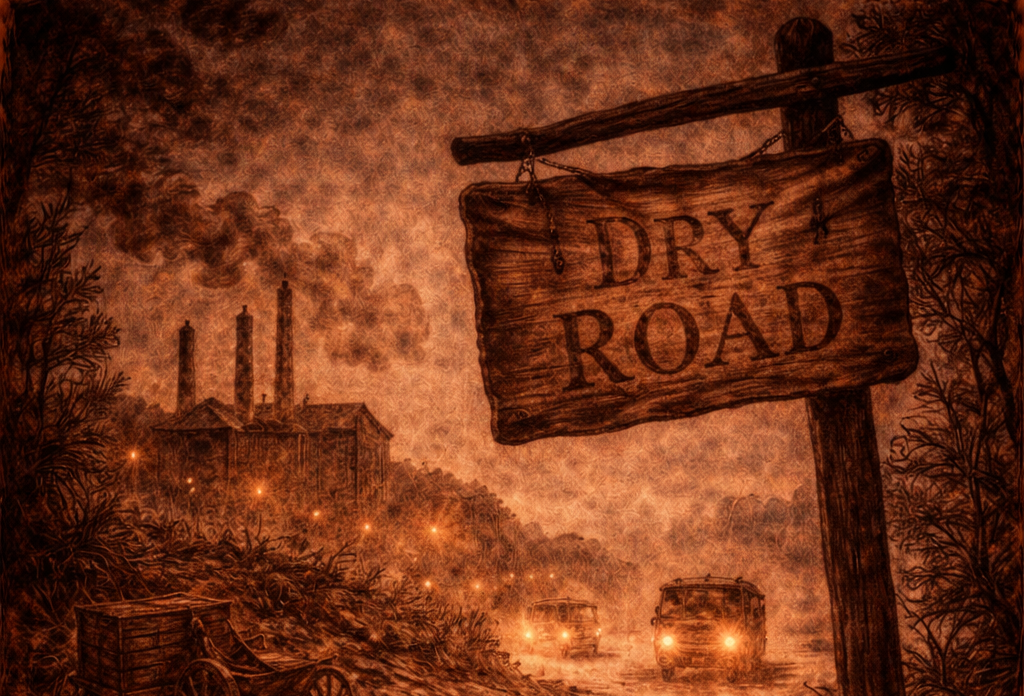
This fragment belongs to the world of Ashes & Iron, where survival often depends on routes that never appear on maps.
Lost Chapters in the Quiet Trades cycle follow the infrastructure of necessity: roads worn smooth by repetition, labor performed without witnesses, and crimes committed not for excess, but for continuity. These scenes can be read in any order. They are not required to understand the books — but they reveal how towns learn to live beside illegality, and how certain paths exist only because too many people need them to.
They called it the Dry Road because nothing legal traveled it.
Not after dark.
By daylight it looked like nothing worth naming. A service path at best. A mistake in the land at worst. It ran behind the foundry, skirting slag piles and the remains of broken carts that no one bothered to clear. The ground stayed hard there, packed down by years of weight and repetition, compressed by secrets heavy enough to leave grooves.
No lamps lined it.
No signs pointed the way.
If you did not already know where it was, you would not find it. And if you did find it by accident, you would not linger.
The ruts ran deep, deep enough to remember every load that had passed through them. They held water after rain and froze early in winter, preserving impressions like records no one bothered to destroy. Wheels followed the grooves because deviation invited trouble. On the Dry Road, staying in line was safer than choosing your own path.
On those nights, the trucks moved slow.
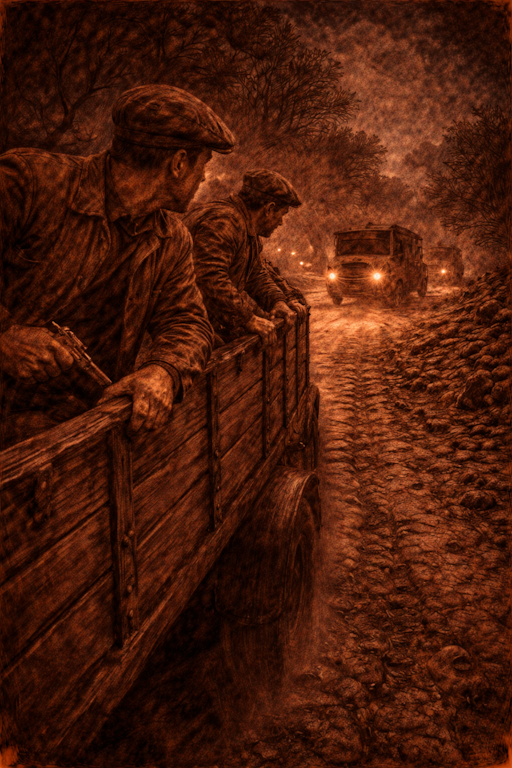
Engines were kept low, tuned to a steady murmur rather than a roar. Headlights were hooded, beams narrowed to slits that showed just enough road to avoid disaster and no more. The men riding the running boards stood with knees bent, bodies loose, absorbing motion the way experienced hands absorbed heat.
One hand stayed on the rail.
The other stayed empty.
Empty hands could wave.
Empty hands could let go.
Depending on who stepped out of the dark.
They watched for movement that didn’t belong to the night. For the wrong kind of silence. For sounds that arrived too cleanly, like boots that had never known mud. Whistles carried differently in the open, and every man knew the sound well enough to hear it even when it wasn’t there.
This wasn’t crime for profit.
It was crime so the town could keep eating.
Grain moved that way. Barrels sealed tight and marked for destinations that never appeared in writing. Solvent that would become something else by the time it reached a warm room. The road did not care what the cargo was called. It only responded to weight.
Once, a truck stalled on the grade.
It happened where the road lifted just enough to make engines complain, a long, shallow rise that punished hesitation. The engine coughed once, then again, then went quiet. The sudden absence of sound felt louder than any backfire.
No one swore.
No one prayed.
The driver leaned forward, hands steady on the wheel, listening. Not to the engine. To everything else.
Boots.
Whistles.
Breath that did not belong to him.
Men shifted their weight without stepping down. No one spoke. Words would have made the moment too real, pinned it in place. Silence gave it room to resolve itself one way or another.
The engine caught again with a shudder that ran through the frame and into every rib standing on the boards. The truck lurched forward, climbing past the worst of it, tires finding their old grooves like they had never left them.
When the grade fell away and the road leveled out, every man laughed too loud.
The sound came out fast and unmeasured, breaking against the trees and scattering into the dark. It wasn’t relief, not exactly. It was release. A way of proving to themselves that the fear had passed through them cleanly and left nothing behind.
Fear, shared properly, sounded a lot like joy.
The Dry Road carried on behind them, waiting for the next load. It never advertised itself. It did not need to.
Enough people depended on it to keep it alive.
Some roads exist because too many people need them to disappear.
This moment belongs to the larger world of Ashes & Iron.
The full saga begins where these fragments leave off.

Leave a Reply