

This fragment belongs to the world of Ashes & Iron, where survival often depends on what moves after dark.
Lost Chapters explore the trades that never make it into ledgers: work done quietly, decisions made without witnesses, and mercies extended where law and hunger overlap. These scenes can be read in any order. They are not required to understand the books — but they reveal how crime by necessity takes shape, and how the river becomes not just a boundary, but a participant.
This fragment belongs to the world of Ashes & Iron, where survival often depends on what moves after dark.
Lost Chapters explore the trades that never make it into ledgers: work done quietly, decisions made without witnesses, and mercies extended where law and hunger overlap. These scenes can be read in any order. They are not required to understand the books — but they reveal how crime by necessity takes shape, and how the river becomes not just a boundary, but a participant.
Not everything the river carried was lost by accident.
Some things were put there on purpose, guided into its hands the way you guided a horse into water it already wanted. The river did not argue. It accepted weight without comment and returned only what it chose.
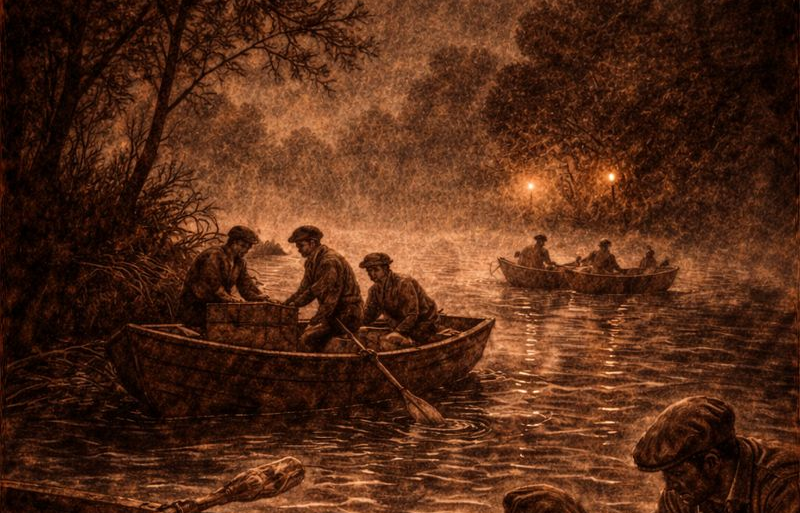
At night, the boats came quiet.
No lamps. No voices raised above breath. Oars were wrapped in cloth so the water would not remember their sound. Even the men seemed dimmer then, outlines rather than faces, bodies reduced to movement and intention.
Crates were passed hand to hand, lifted carefully to avoid knocking wood against wood. Grain for bakeries that could not afford delays. Bottles sealed tight, their labels still clean, meant for tables that pretended not to know where warmth came from. Things the law preferred to arrive unseen.
The river did not mind.
It had always been good at keeping secrets.
It carried the boats the way it carried everything else: without judgment, without attachment. The current moved steady and sure, the same path it had followed long before anyone decided to argue with it over borders and taxes. Men adjusted their weight and trusted the water to do the rest.
They worked quickly. Speed mattered less than silence. Every movement had been practiced until it became smaller than thought. Hands knew where to go. Feet found purchase without looking. No one spoke unless the river forced them to.
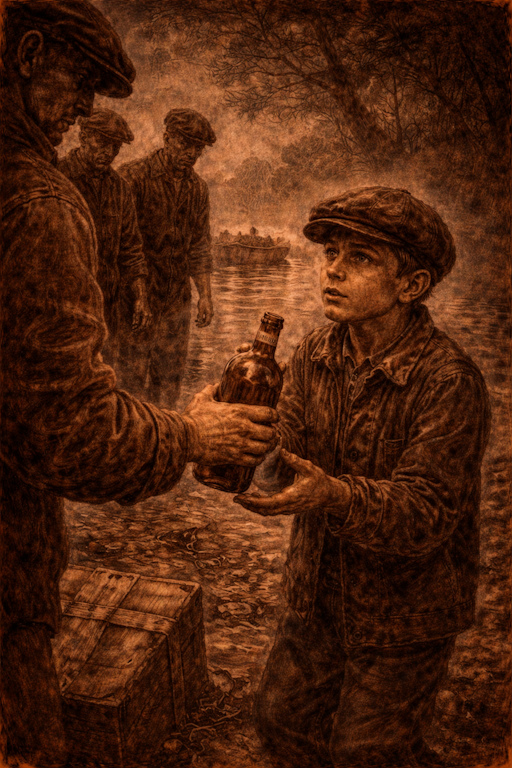
On the bank, a boy waited.
He was young enough that his boots were borrowed and a size too large, the leather creasing where his feet did not quite reach the ends. He had been told where to stand and what not to touch. He nodded more than he spoke. That was how boys were allowed to stay.
When it happened, it happened fast.
The mud gave way under his heel. Not much. Just enough. The crate slipped. Wood struck stone with a sound that seemed impossibly loud in the quiet. Glass cracked inside. A thin, sharp sound, followed by the softer one of liquid finding ground.
Whiskey bled into the mud.
The men froze.
Not in panic. In calculation. One glance at the river. One toward the trees. One at the boy, who stood still as if movement might make it worse. His face had gone pale, eyes wide, breath shallow and fast. He did not reach for the crate. He did not apologize.
He knew better than to speak first.
They looked at him and understood.
This was not greed.
This was not carelessness.
This was hunger wearing borrowed boots.
One of the men knelt and picked up the crate, testing its weight. He shook his head once, then waved the others on. The work did not stop. It rarely did. Another man reached into the broken slats and pulled free a bottle, intact, its glass cool and dark.
He pressed it into the boy’s hands.
“Not for selling,” he said quietly.
The boy nodded.
“For warming,” the man added, already turning away.
No one lingered. No one explained. The river carried the boats back into motion, fog folding around them as if it had learned how to make men disappear. In moments, there was nothing left but churned mud and the faint smell of grain and alcohol mixing into something older.
The boy stood there long after they were gone.
He did not drink. Not yet. He held the bottle against his chest, feeling its weight, the way it seemed heavier than it should be. Some warmth was not meant to be used immediately. Some things were carried home.
Across the water, someone watched from the trees.
No badge.
No uniform.
Just a man standing far enough back to remain a thought rather than a presence. He did not take notes. He did not signal anyone else. He watched the work, the boy, the exchange, and the way the river erased evidence without being asked.
He was learning.
Which names belonged on which side of the river.
Which hands passed crates and which ones accepted bottles.
How mercy moved through the trade without ever being written down.
He did not intervene. Not yet.
There was time for that later.
The river flowed on, carrying what it had been given and keeping the rest. It did not care who watched. It did not care who learned.
It had always known how much mercy people could afford.
The river keeps secrets better than men do.
This moment belongs to the larger world of Ashes & Iron.
The full saga begins where these fragments leave off.

Leave a Reply